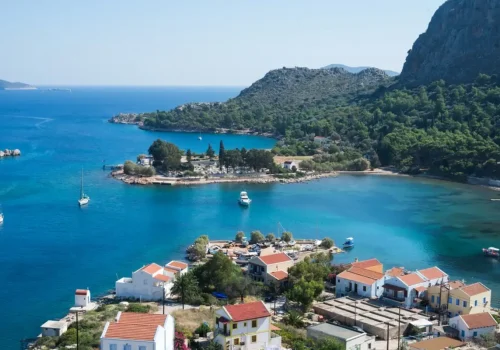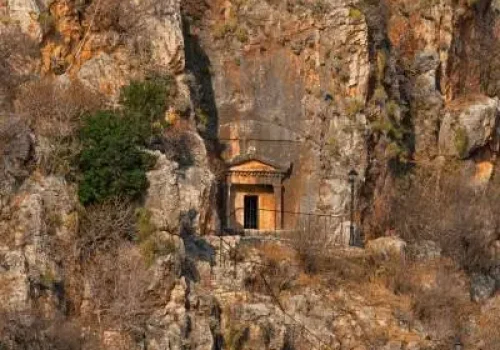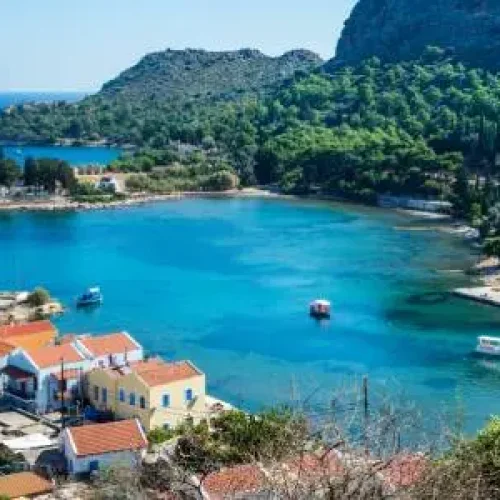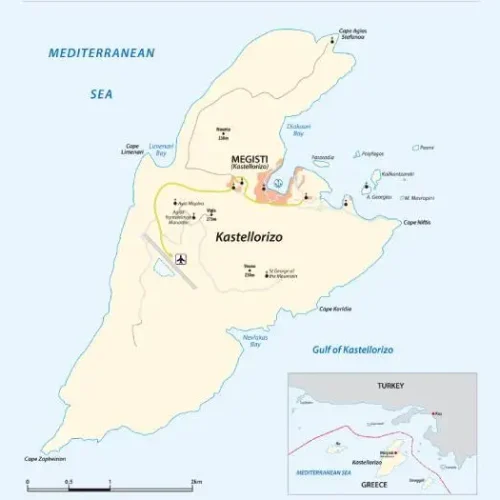
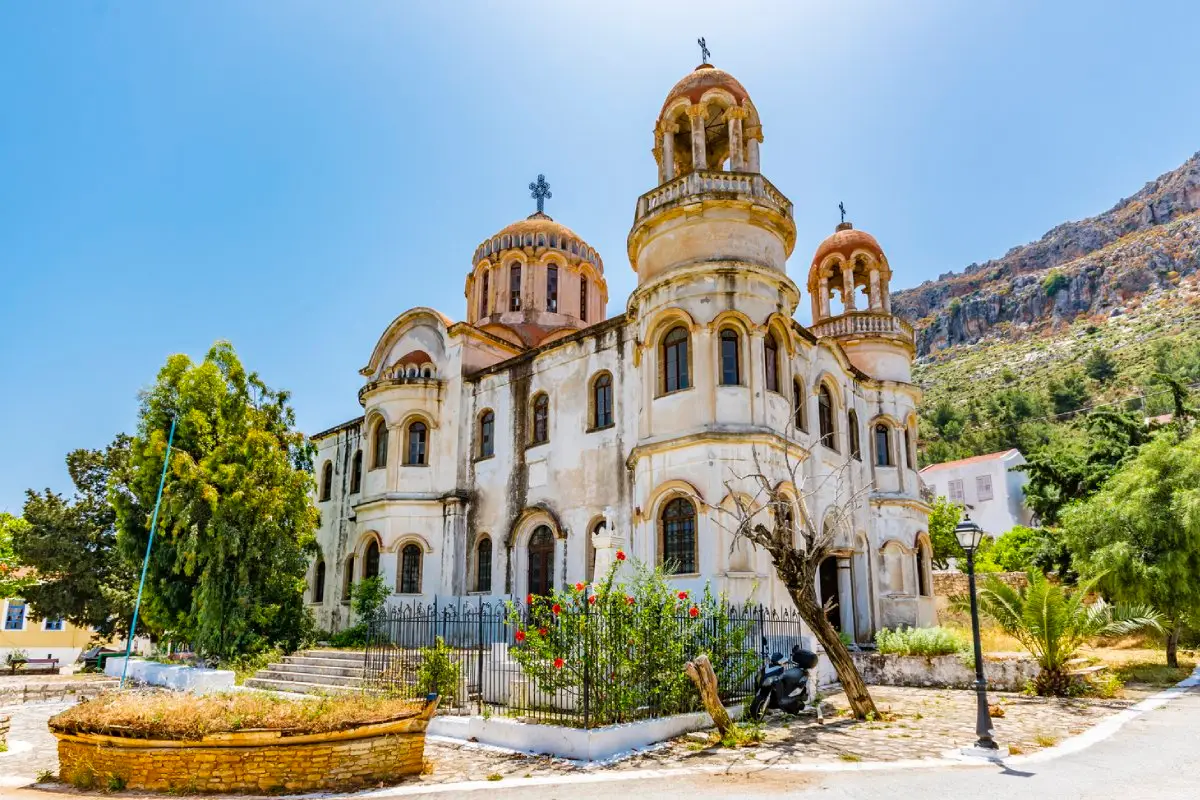
The Church of St. George is one of the most significant historical landmarks of Meis Island, also known as Kastellorizo. Located on the hill overlooking the island, this Byzantine-style church reflects the rich religious heritage of Meis Island.
Originally built in 1751 as a small two-story monastery with a tiled roof, the site was later expanded. In 1905, a new stone church was constructed behind the bell tower and officially opened for worship in 1909.
The architecture of St. George Church in Kastellorizo follows the Byzantine iconographic tradition. The interior dome and ceiling decorations
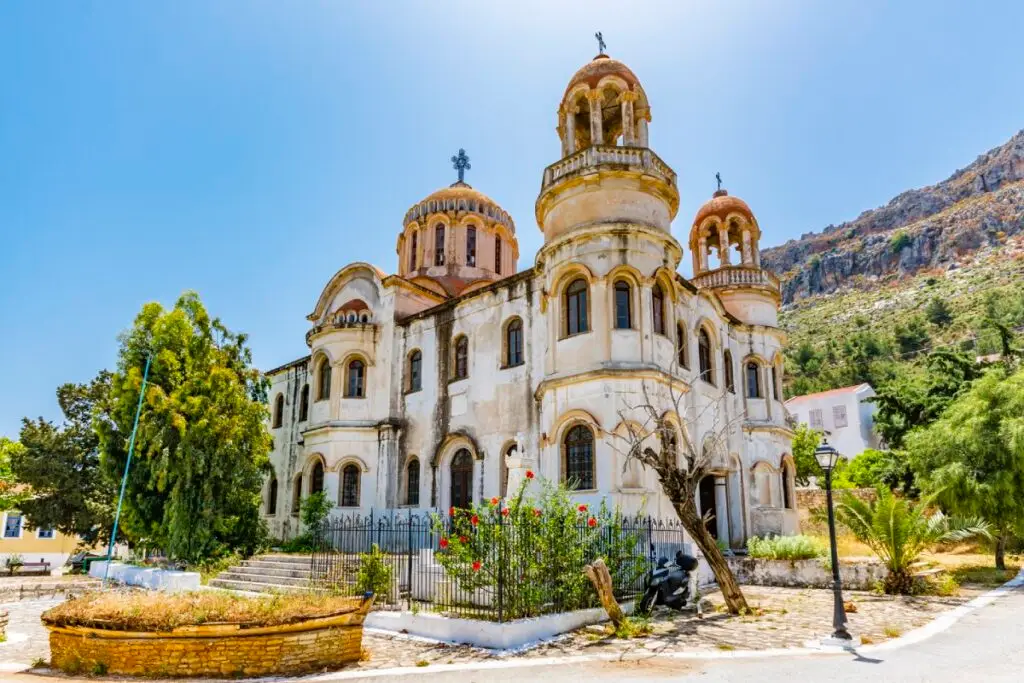
On Meis Island, the Church of Aya Yorgi is located in the Pigadi area and stands at one of the highest points of the island. Thanks to this location, it offers visitors an impressive experience both in terms of scenery and architecture. The walking paths and natural landscape surrounding the church are also striking.
Interior view of the Church of Saint Georgios (Aya Yorgi) on Meis Island. The visible dome and ceiling decorations follow the Byzantine iconographic tradition.
At the top of the dome, a scene depicting the Crucifixion of Jesus is illustrated.
- In this scene, the ascent of Jesus to Golgotha (carrying the Cross), His crucifixion, and His triumph after the Resurrection are symbolically represented together.
- The Crucifixion of Jesus is regarded in Christianity as the greatest sacrifice made for the forgiveness of humanity’s sins.
- The Resurrection (Easter) symbolizes victory over death and the promise of eternal life for believers.
Icons of saints, angels, and scenes from the Bible are depicted on the side windows and around the base of the dome.
The church’s interior decoration demonstrates that it serves not only as a place of worship but also as a “visual Bible,” conveying sacred narratives to the faithful.
Thus, the scene in the dome represents an iconographic composition that symbolically unites Christ’s suffering before the Crucifixion, His sacrifice on the Cross, and the miracle of the Resurrection.
Combined with the light filtering through the colorful stained-glass windows, these sacred scenes transform the church into a living visual Gospel.
Within the square courtyard of the Monastery of Saint George, there is a small church, several cells, and auxiliary rooms. Descending ten steps inside the monastery leads to an unusual underground crypt dedicated to Saint Charalambos. This crypt contains a large water spring.