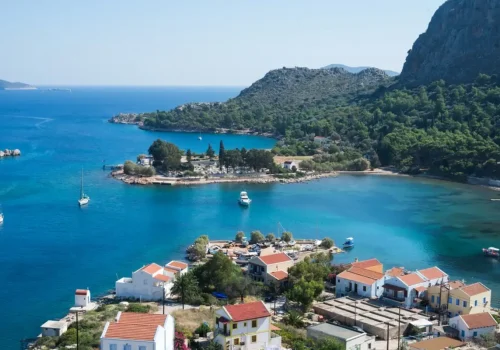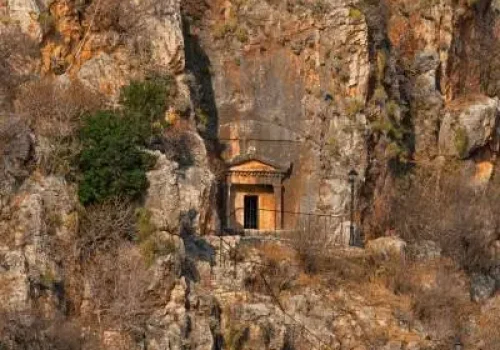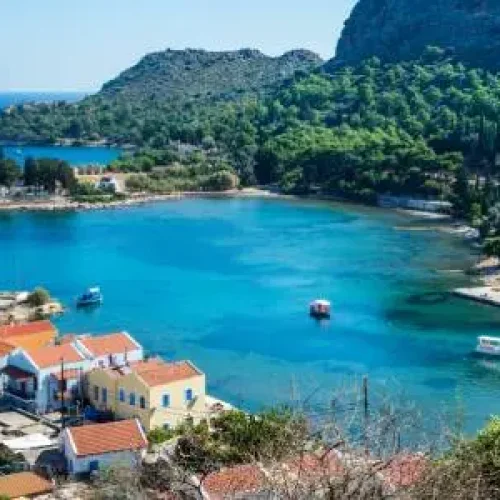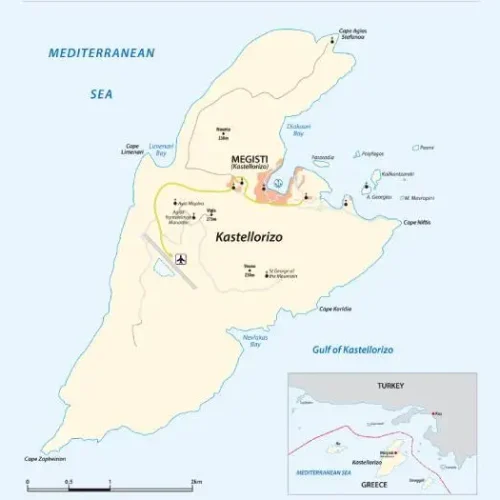
In its earliest periods, the island was colonized by the Dorians and was named Megisti. Inscriptions found at the Aya-Nikolon (Old Castle) fortress confirm that throughout the Hellenistic Period, the island was governed by Rhodes. The Rhodians used to send a chief inspector to the island.
During the Byzantine Empire, Kastelorizo–Megisti was part of the “Province of the Islands,” whose capital was Rhodes. This province was primarily dependent on maritime activities. Throughout the Middle Ages, the Byzantines and the Ottomans struggled to seize control of the island.
In 1306, the Knights of St. John of Jerusalem, led by Folques de Villaret, took control of the island while en route from Cyprus to Rhodes. Three years later, they conquered Rhodes and made it the center of the Crusader State. The knights restored the castle and used it as a prison for disloyal members. In 1440, the island was occupied by the Egyptian Sultan Cemalettin, and the castle was destroyed. Ten years later, the island was conquered by Alfonso V of Aragon, King of Naples. The castle was rebuilt and a governor was appointed to the island. The Kingdom of Naples held the island until 1512, when it was conquered by Suleiman the Magnificent.
On September 22, 1659, during the Cretan War, the island was captured by Venice and the castle was once again destroyed; however, the Ottomans regained control shortly afterward.
Between 1828 and 1833, Kastelorizo (Kızılkale) joined the Greek uprising, but after the end of the Greek War of Independence, it returned to Ottoman rule.
In 1912, during the Italo-Turkish War in Libya, the islanders requested to be annexed to Italy by appealing to General Ameglio, commander of the Italian occupation forces in Rhodes. When this request was rejected, they seized the Ottoman garrison on March 14, 1913, and declared a provisional government. Until August of the same year, the Greek government sent an inspector supported by gendarmes from the island of Samos. These forces were expelled by the islanders on October 20, 1915. On December 28, 1915, French military units arriving aboard the cruiser “Jeanne d’Arc” landed on the island and prevented Greek Evzones from disembarking at the same time. Turkish coastal batteries responded to the French occupation by bombarding the island and, in 1917, succeeded in sinking HMS Ben-my-Chree. According to the terms of the Treaty of Sèvres, the island was handed over to Italy, and the Italian navy took control from the French navy on March 1, 1921. Kastelorizo—Italian for Kızılkale—thus became part of the Italian Aegean Islands.
In 1932, under the agreement defining maritime borders between Italy and Turkey, all the small islets around Kastelorizo—except Rho and Strongili—were ceded to Turkey. During the 1930s, the island served as a stopover for Italian and French aircraft traveling from Rome to Beirut.
During World War II, on February 25, 1941, British commandos occupied the island; however, Italian forces arriving from Rhodes soon regained control. When Italy surrendered to the Allies (September 8, 1943), British commandos briefly reoccupied the island, but in 1944 German forces took control. During the British withdrawal, a fuel depot caught fire and the flames spread to a nearby ammunition dump. The explosion destroyed half of the houses on the island.
Under the terms of the 1947 Paris Treaty, Kastelorizo was ceded to Greece. In May 1947, it was still under British administration, but on September 15, 1947, it was effectively transferred to Greek control. The island was officially incorporated into the Greek state together with the Dodecanese on March 7, 1948.
In recent years, the island has been visited mainly by tourists traveling to the less-crowded Dodecanese Islands and due to the 1991 film “Mediterraneo,” directed by Gabriele Salvatores, which won the Academy Award for Best Foreign Language Film in 1992. Kastelorizo was also the only European Union territory where the March 29, 2006, total solar eclipse was fully visible.